ShadeFix, not an optimiser on every panel
SMA's shade management optimises string output electronically — on the flue-and-rooflight-cluttered roofs most businesses have, it recovers yield without the cost of an optimiser on every panel.
Inverters
SMA is the longest-established name we fit: a German manufacturer that has been building solar inverters since 1981, from a headquarters in Niestetal where it still engineers them today. For commercial roofs we specify two lines — the Sunny Tripower X (12–25 kW) for most buildings, and the Sunny Tripower CORE1 (50 kW) where the roof is big enough to earn it. Neither is the cheapest box you can bolt to a wall. They are the ones we recommend when a client asks the right question, which is not "what does an inverter cost?" but "what does a decade of it running without drama cost?"
Middle of the road is where we deliberately position SMA in our range: proven, serviceable, sensibly priced for what it is. The specifications below come from SMA's own datasheets, and the warranty section tells you the part the glossy brochures skip.
 Manufacturer image · sma.de
 The commercial all-rounder
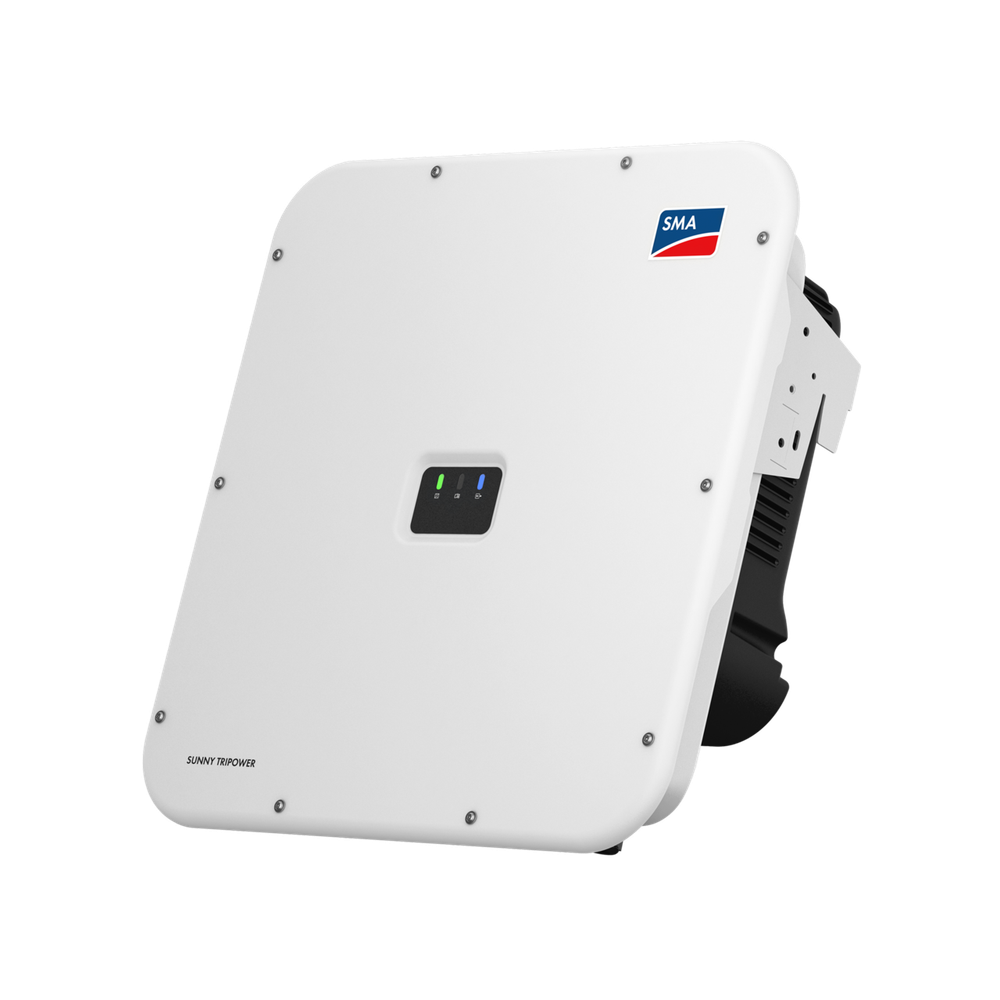
The Tripower X is the inverter we specify for most farm and light-industrial roofs: four power classes at 12, 15, 20 and 25 kW, three MPP trackers, a 1,000 V maximum DC input and a maximum efficiency of 98.2% (98.0% European weighted). The 25 kW unit accepts a PV array of up to 37.5 kWp — at today's typical 450–500 W commercial panels, roughly 75 to 83 panels on one inverter.
Two features earn their keep on real roofs. ShadeFix optimises string output electronically — recovering yield on cluttered roofs without an optimiser on every panel. And the integrated System Manager monitors and controls up to five inverters (135 kVA) with direct Sunny Portal access, so a multi-inverter roof behaves as one system. Arc-fault detection (ArcFix) is built in, and at under 59 dB(A) the unit will not dominate a working yard.
By the datasheet
Drawn from SMA's own Sunny Tripower X and CORE1 datasheets — the same figures the sections on this page cite in full.
12–25 kW
Sunny Tripower X
four power classes · three-phase
50 kW
Sunny Tripower CORE1
free-standing · six MPP trackers
98.2%
Tripower X max efficiency
98.0% European weighted
37.5 kWp
PV per Tripower X 25
≈75–83 panels at 450–500 W
up to 150%
CORE1 PV oversizing
twelve direct string inputs
up to 5
Inverters per System Manager
135 kVA · Sunny Portal
<59 dB(A)
Tripower X noise
won't dominate a working yard
1981
Building inverters since
≈45 years · publicly listed
 Manufacturer image · sma.de
 For the big sheds
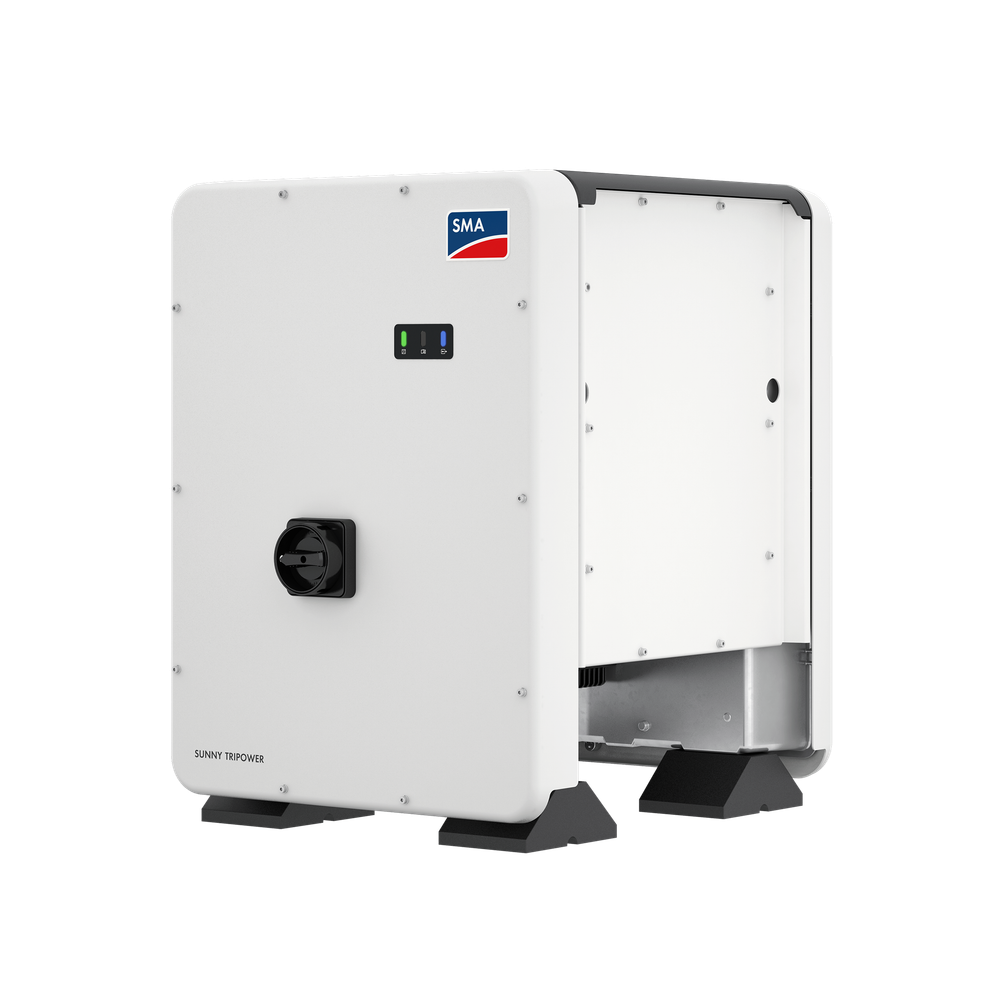
For the warehouse and factory roofs our commercial solar work is built on, the CORE1 is a 50 kW three-phase string inverter with six independent MPP trackers and twelve direct string inputs — and it was the world's first free-standing string inverter: it stands on the roof or ground like a site cabinet, no wall-mounting frame, no plant-room wall given over to electronics.
SMA claims installation-time reductions of up to 60% from that design; we will not promise you their number, but the saved steelwork and the six-tracker flexibility on a complicated roof are real. It accepts PV oversizing up to 150%, actively cools itself (OptiCool), and parallels cleanly — SMA rates the platform as scalable to megawatt-class projects, which means one product family covers everything from a 50 kW farm roof to the largest schemes we would take on.
Why we specify SMA
SMA's shade management optimises string output electronically — on the flue-and-rooflight-cluttered roofs most businesses have, it recovers yield without the cost of an optimiser on every panel.
The integrated System Manager monitors and controls up to five inverters (135 kVA) with direct Sunny Portal access, so a multi-inverter roof behaves as one system — quietly removing a line from the quote.
The world's first free-standing string inverter stands on the roof or ground like a site cabinet — no wall-mount frame, and the saved steelwork and six-tracker flexibility on a complex roof are real.
The Tripower X 25 accepts up to 37.5 kWp against its 25 kW output and the CORE1 tolerates oversizing up to 150% — exactly what a flatter North East winter yield needs.
Home and business
The Tripower X and CORE1 are commercial inverters, but the same string-inverter engineering carries down to a home roof — and either way the battery AC-couples alongside.
| For your home | For your business | |
|---|---|---|
| Typical inverter | A smaller SMA string inverter | Sunny Tripower X (12–25 kW) or CORE1 (50 kW) |
| Where it fits | Homes and small commercial roofs | Farm, industrial and warehouse roofs |
| Battery | AC-coupled, added separately | AC-coupled — Fox ESS or Sigenergy |
| Shade handling | ShadeFix | ShadeFix |
| Monitoring | Sunny Portal | System Manager — up to five inverters |
| Backed by | ≈45 years of SMA | ≈45 years of SMA |
Heritage is cheap to claim and easy to check, so here is the checkable version. SMA Solar Technology AG was founded in 1981, employs around 3,500 people, sells through subsidiaries in 19 countries, and turned over €1.5 billion in 2025. It is a publicly listed company that has survived every boom and cull the solar industry has produced in four and a half decades — which matters for one very practical reason: the warranty on your inverter is only worth the odds of the company existing to honour it in year nine. On that measure, SMA is the safest bet in our catalogue, and we say so while still fitting the younger brands where their maths wins.
Oversizing is where an inverter choice quietly makes or loses money this far north. A County Durham roof typically yields 800–950 kWh a year per kWp installed — less than the south coast, with flatter winter output — so the economically right design usually hangs more panel capacity on the inverter than its AC rating suggests: the panels rarely all peak at once, and the extra capacity is what keeps winter generation useful. Both SMA lines are built for exactly that: the Tripower X 25 accepts up to 37.5 kWp against its 25 kW output, and the CORE1 tolerates oversizing up to 150%. It is a detail, but it is the detail that separates a system designed from PVGIS yield data for your postcode from one copied off a sunnier brochure — and you can sanity-check the numbers yourself on our savings calculator.
Here is the straight talk a brochure will not give you: the Tripower X and CORE1 are pure grid-tie string inverters. They have no battery port. If your project includes storage — and for daytime-light businesses it often should — the battery runs as a separate AC-coupled system alongside the SMA kit: our Fox ESS or Sigenergy systems do exactly that job. That two-box architecture is not a defect; on larger commercial sites it is often the better engineering, because the solar and storage can be sized, placed and serviced independently. But it is a design decision with cost implications, and you should hear it at quote stage from your contractor, not at delivery stage from an installer who hoped you would not ask.
SMA's factory warranty on these models is five years as standard in Europe, extendable to 10, 15 or 20 years through SMA's paid warranty extension programme — and because SMA has recently moved some markets to ten years as standard, we confirm the exact current term in writing on every quote rather than letting a datasheet footnote decide it. Either way, our planning assumption for you is the same one we use for every brand on this site: an inverter is a 10-to-12-year component in a 25-to-30-year solar system. Budget for one inverter replacement across the array's life and the investment case never gets an ugly surprise; the difference with SMA is that the company's four-decade track record makes the year-nine service call the least worrying in the industry.
Because the inverter is the component that works hardest and fails first in any solar system, and the price gap buys three specific things: a manufacturer with 45 years of surviving this industry, a service and spares operation on this side of the world, and electronics engineered in-house rather than badge-engineered. If the capital budget is the binding constraint, we will say so and quote accordingly — our Fox ESS hybrid systems exist in the range for exactly that reason. What we will not do is pretend the boxes are interchangeable.
It genuinely depends, and the deciding factors are usually structural and electrical rather than brand-level: string layout around rooflights (six trackers on the CORE1 versus three per Tripower X), where the DC runs can go, and whether a free-standing unit or two wall-mounted ones suits the building. This is the sort of question our surveys exist to answer with your actual roof drawings — and it is also why an electrical contractor doing the design beats a sales office picking from a price list.
Also in our range
Commercial solar, battery, EV or any electrical work — no pressure.