
Commercial Solar · Northumberland
Commercial solar in Blyth, where offshore wind began
On 7 December 2000, the ribbon was cut on Britain’s first offshore wind farm — not off Kent or the Dogger Bank, but in Blyth Harbour. This town was generating renewable electricity at commercial scale before most of the country had heard the phrase "net zero", and it never stopped: today the Energy Central partnership around the estuary — Port of Blyth, Northumberland County Council, Advance Northumberland and the Offshore Renewable Energy Catapult — anchors one of the UK’s densest clusters of offshore-energy engineering.
That matters here, because a Blyth business does not need solar explained as a novelty. The Catapult’s Blyth facilities test the turbines and cables the rest of the industry builds; JDR Cables is investing £130 million in a subsea-cable factory at Cambois, creating around 170 jobs and safeguarding 270 more; and the port styles itself, with justification, a leading UK offshore energy support base. Rooftop solar here is not an import — it is the town’s own industry, scaled down to fit your building.
Blyth is also, at 39,731 people, Northumberland’s largest town — with the £90 million Energising Blyth programme in delivery and the Northumberland Line returning passenger trains in December 2024 after sixty years. From our County Durham base it is a little over fifty road miles; solar is planned, multi-day work, and the plan includes the road.
Solar on Blyth's commercial buildings
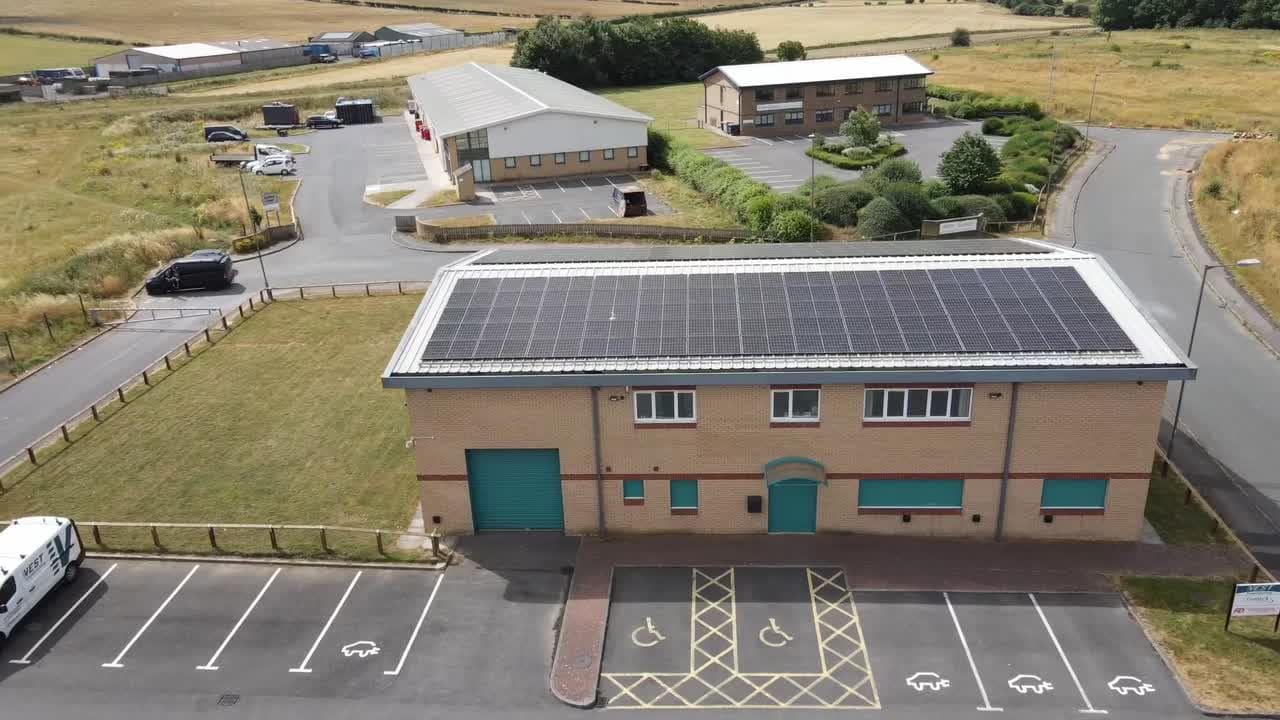
The working stock follows the water and the A189: port-side sheds, engineering workshops, distribution units and trade-counter estates, most of it steel portal frame under profiled sheet — the roof type we would choose if we could choose. At depot scale the numbers run like this: a 150 kWp array returns roughly 120,000–142,500 kWh a year at North East yields, flatter sheets sitting toward the bottom of the band. Port operations, fabrication and logistics all draw through daylight hours, which keeps the generated units on site at full import value.
Coastal buildings add one honest engineering layer that inland pages never mention: salt. Marine air is corrosive, and a system a few hundred metres from the North Sea should be specified for it — corrosion-rated rails and fixings, panels tested against the salt-mist standard, inverters mounted indoors out of the weather. None of it is exotic or optional this close to the water — it is the difference between a system that lasts its design life and one shedding fixings in year ten.
The energy cluster cuts one more way. A town full of people who engineer generation for a living will ask a solar installer harder questions than most — about yield assumptions, degradation, export limits — and we would rather be in a town like that. Our assumptions are published on the calculator page; the G99 application to Northern Powergrid is agreed before installation; where a battery makes the evening shift viable we size it from your half-hourly data, not a brochure. And the wider electrical scope — boards, distribution, testing — is our founding trade.
What Northumberland County Council is doing
Northumberland County Council is the planning and rates authority, with Blyth Town Council at parish level — and in Blyth the county’s net-zero policy has a visible spending programme attached. Energising Blyth’s £90 million (built from a £20.9m Town Deal, £11.12m from the Future High Streets Fund and further council and partner investment) is regenerating the town centre and estuary, and £2 million of that Town Deal helped fund the Catapult’s £6 million Technology Development Centre for offshore-wind innovators.
The county targets behind it — a carbon-dioxide-neutral council by 2030, county-wide net-zero greenhouse gases by 2040 — read differently in a town that already builds the hardware. Most commercial rooftop arrays here proceed under permitted development; where prior approval or an export limit enters the picture, we handle both.
Local facts, sourced
Blyth in numbers
Every figure below comes from a named public source — the same standard we hold our savings estimates to.
-
Britain's first offshore wind farm opened in Blyth Harbour on 7 December 2000 — this town has generated renewable power at commercial scale for a quarter of a century.
Source: Ember — ember-energy.org; en.wikipedia.org/wiki/Blyth_Offshore_Wind_Farm
-
The Energy Central partnership — Port of Blyth, Northumberland County Council, Advance Northumberland and the Offshore Renewable Energy Catapult — anchors the offshore-energy cluster around the Blyth estuary.
Source: Energy Central UK — energycentraluk.co.uk
-
JDR Cables is investing £130m in a subsea-cable manufacturing facility at Cambois, creating around 170 local jobs and safeguarding 270 existing ones.
Source: ORE Catapult — ore.catapult.org.uk ("Levelling Up for Blyth"); Energy Central UK
-
The £90m Energising Blyth programme — including a £20.9m Town Deal and £11.12m from the Future High Streets Fund — is regenerating the town centre and estuary through 13 major projects.
Source: Northumberland County Council — northumberland.gov.uk (Energising Blyth)
-
Blyth is Northumberland's largest town, with 39,731 people at Census 2021.
Source: ONS Census 2021 — censusdata.uk (E63000050)
-
The Northumberland Line returned passenger trains to the Blyth area in December 2024 after around 60 years, with Newsham station — Blyth's own stop — opening in March 2025.
Source: Northumberland County Council — northumberland.gov.uk/News/2024/Dec; Nexus — nexus.org.uk (Newsham opening)
-
ORE Catapult's £6m Technology Development Centre in Blyth — part-funded by £2m from the Blyth Town Deal — gives offshore-energy innovators test and validation facilities in the town itself.
Source: ORE Catapult — ore.catapult.org.uk (TDC press release)
Data last reviewed: July 2026
Our work across the North East
The next step
The first town in Britain to put turbines offshore should have no patience for vague solar quotes. See the wider Northumberland picture, check the assumptions we publish, or give us a roof to price properly.
Blyth commercial solar questions
Does salt air off the North Sea shorten a solar system's life?
It shortens the life of a badly specified one. Close to the coast we specify corrosion-rated aluminium and stainless fixings, panels tested to IEC 61701 — the salt-mist corrosion standard — and inverters mounted inside the building. Ask any installer quoting in Blyth what their coastal specification is; if the answer is a blank look, get a second quote.
Half this town works in offshore wind — why would we bother with panels on our own roof?
Different tools for different jobs. Offshore wind decarbonises the grid you buy from; a rooftop array cuts how much of that grid electricity you have to buy at all. The wind farm does nothing for your unit rate — your own roof, used well, takes a slice of your bill out of the market permanently.
With the port and new factories growing, will Northern Powergrid have export room left for us?
On a growing industrial network, export capacity is not guaranteed — which is why the G99 application goes in at design stage, before anything is bought. If the network offers an export limit, we design to it; a well-sized commercial system uses most of its output on site anyway, so a constrained export rarely kills the case. Discovering the constraint after the panels are up is the order we refuse to work in.
Can Energising Blyth money pay for our solar?
No — and better you hear that from us. Energising Blyth is a place-regeneration programme funding town-centre, culture, skills and infrastructure projects; it is not a grant pot for private solar installations. The supports that do exist are national — business-rates exemption on onsite solar until 2035 and capital allowances on the spend — covered honestly in our FAQs.
Nearby
We also cover Morpeth commercial solar installers, commercial solar in Cramlington and solar for Hexham businesses.
Get a straight answer for your Blyth site
Get your free, no-obligation quote
Commercial solar, battery, EV or any electrical work — no pressure.