
Commercial & Agricultural Solar
Commercial solar across County Durham
County Durham is where we live, where the company is registered and where most of our work sits. The base is at St Helen Auckland on the edge of Bishop Auckland; the registered office is in Spennymoor; the landline is a 01388 number. When we say Durham comes first, it is a statement of geography, not marketing.
It is also, quietly, one of the better counties in England to own a commercial roof. Over half a million people live here — 522,100 at the last census, making it the largest local-authority area in the North East — and they are served by a working economy that still makes, stores and moves physical things. The buildings that economy runs on are overwhelmingly the kind solar was made for: wide-span portal-frame sheds with sheet-metal roofs, on estates that were laid out for industry and never stopped being used for it.
Start with the scale of the estate network. Aycliffe Business Park at Newton Aycliffe covers around 700 hectares, holds more than 500 businesses and employs roughly 10,000 people — the biggest single employment area in the county, and now reckoned the biggest business park in the North East. At Bowburn, just off junction 61 of the A1(M), the 205-acre Integra 61 scheme is bringing forward up to three million square feet of industrial and logistics space, with Amazon already on site. On the coast near Seaham, the £120 million Jade Business Park at Murton has capacity for up to a million square feet, with Sumitomo Electric Wiring Systems its first tenant. And at Sedgefield, NETPark — the county’s £85 million science and technology park, home to two national Catapult centres — is a measure of where the county thinks its economy is going: the park’s third phase is being designed with no connection to the gas network at all, with a solar farm under consideration alongside it.
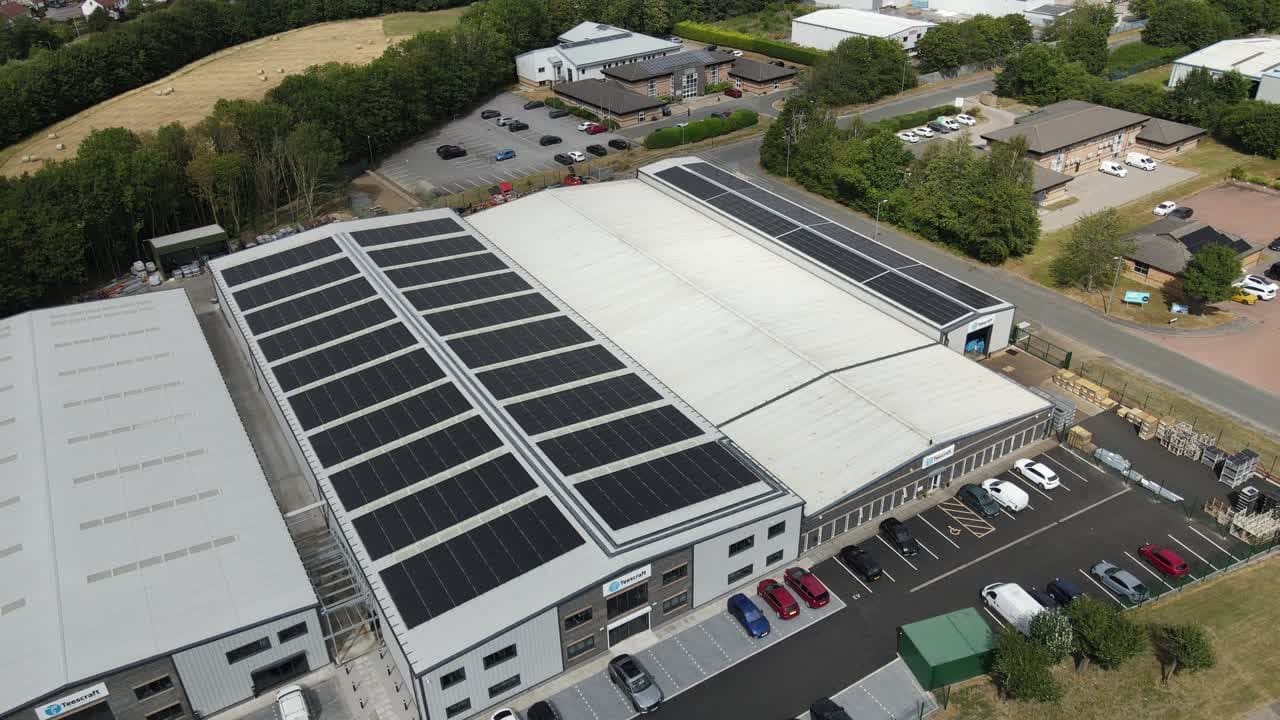
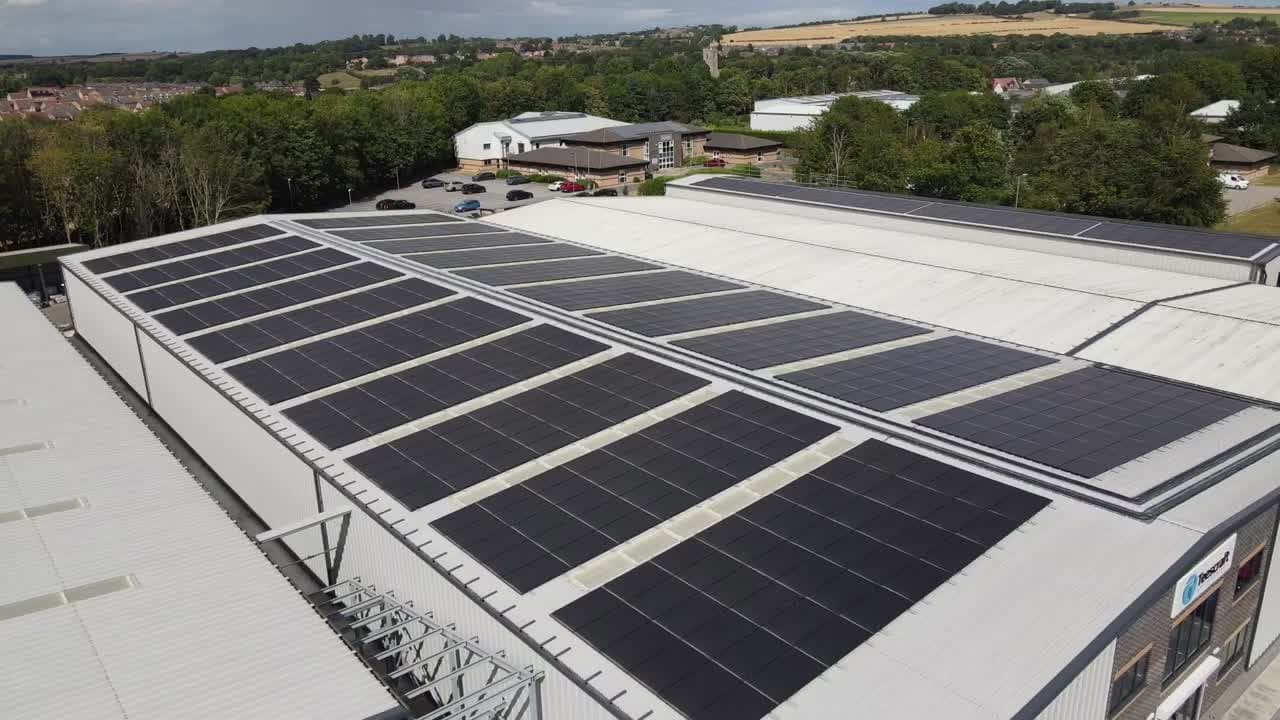
Every one of those sites is a concentration of exactly the roof type we prefer to work on. A trapezoidal or standing-seam steel roof takes a clamp-mounted array without wet trades and, on many profiles, without a single penetration. The yield this far north is honest rather than heroic — plan on the 800–950 kWh per installed kWp band for a well-oriented roof, and the bottom of it for shallow-pitch sheds — but a business that uses its power in the daytime keeps far more of the value of each unit than any export tariff pays.
Then there is the other County Durham: the farmed west. Beyond Crook and Willington the county climbs into Weardale, and from Wolsingham up the dale the holdings are livestock farms with steel-framed sheds, strong daytime loads where dairying and refrigeration persist, and long distances from the nearest substation — all of which makes a properly designed roof array more useful there, not less. Agricultural buildings are a core part of what we do, not a sideline, and the same is true across the county’s arable east towards Sedgefield and Ferryhill.
The council’s direction of travel helps the case. Durham County Council declared a climate emergency and now works to twin targets: net-zero for its own operations by 2030, and net-zero for the county as a whole by 2045, with its third Climate Emergency Response Plan running 2024–2027. It has already cut its own emissions by 64% since 2008/09 — this is a council that treats decarbonisation as delivery, not decoration, and county businesses generating their own power are pushing in the same direction it is.
One more thing we bring to a County Durham job that a visiting installer cannot: thirty years of electrical contracting in this county. If the survey turns up a distribution board that will not take an inverter, or a fixed-wire test that is overdue before anything new is connected, the same firm handles it — one contractor, one accountable name.
Local facts, sourced
County Durham in numbers
-
Durham County Council is working to net-zero targets of 2030 for its own operations and 2045 for the county as a whole, under its third Climate Emergency Response Plan (2024–2027).
Source: Durham County Council — Climate Change Strategy and Emergency Response Plan, durham.gov.uk
-
The council has cut its own carbon emissions by 64% since 2008/09, a reduction recognised with a national award.
Source: Durham County Council, durham.gov.uk/article/32299
-
Aycliffe Business Park covers around 700 hectares with 500+ businesses employing roughly 10,000 people — the biggest single employment area in County Durham.
Source: Aycliffe Business Park, aycliffebusinesspark.co.uk/about
-
NETPark at Sedgefield (£85m invested, two national Catapult centres) is designing its third phase with no gas-network connection, with a solar farm under consideration.
Source: Durham County Council — durham.gov.uk/article/24242 + Climate Emergency Response Plan
-
Integra 61 at Bowburn is a 205-acre site bringing forward up to 3 million sq ft of industrial and logistics space, with Amazon already occupying and 1,000 jobs created.
Source: Durham County Council — durham.gov.uk/article/24242
-
The £120m Jade Business Park at Murton, near Seaham, has capacity for up to 1 million sq ft of employment space; Sumitomo Electric Wiring Systems Europe is its first tenant.
Source: Durham County Council — durham.gov.uk/article/24242
-
County Durham's population was 522,100 at Census 2021 — the largest local-authority area in the North East.
Source: ONS Census 2021 — ons.gov.uk/visualisations/censuspopulationchange/E06000047/
Our work across the North East
Towns we cover in County Durham
Where in the county is your building? Each town page below covers the local estates, the roof stock and the numbers — researched for that town, not templated.
-
Commercial solar in Durham
The city's working ring: Belmont, Dragonville, Bowburn and the Aykley Heads innovation district, plus listed-building work near the World Heritage core.
-
Commercial solar in Bishop Auckland
Home ground: the A688 corridor estates we are based on.
-
Commercial solar in Newton Aycliffe
The North East's biggest business park and the Forrest Park expansion.
-
Commercial solar in Spennymoor
Green Lane, Merrington Lane and DurhamGate; the town our company is registered in.
-
Commercial solar in Consett
The rebuilt town, 900 feet up — Number One Industrial Estate and Hownsgill Park.
-
Commercial solar in Chester-le-Street
The corridor town — Drum, Stella Gill and the A1(M) at junction 63.
-
Commercial solar in Peterlee
The planned factory town — the North West and South West Industrial Estates.
-
Commercial solar in Barnard Castle
Teesdale's market town — farm solar first, from 14 miles up the A688.
And if your business is in Stanley, Seaham, Crook, Shildon, Ferryhill, Sedgefield, Willington or Wolsingham — no dedicated page, same coverage. Those towns are minutes from roofs we already pass; ask us and we will survey yours the same as any other.
Start with the county's most local answer
A survey anywhere in County Durham is a short drive for us, and it costs you nothing but the walk round the building. Bring your last year's electricity bills; we will bring a straight answer.
Get your free, no-obligation quote
Commercial solar, battery, EV or any electrical work — no pressure.