
Commercial Solar · Tyne & Wear
Commercial solar in Newcastle upon Tyne
Newcastle is the one place on our patch where the classic solar building — the wide steel shed under a trapezoidal roof — is not the default. The regional capital’s commercial stock is office blocks, flat roofs, Victorian streets and a working riverside, and putting solar on that mix is a different discipline from clamping rails to an estate unit. Different, but worth doing: this is also the council area with the most aggressive climate target in the North East.
Geography first, because we would rather be checked than doubted: our base is at St Helen Auckland outside Bishop Auckland, about 28 road miles south — call it 45 minutes up the A1(M) on a fair morning. Newcastle is comfortably inside our working range, but we will never pretend a local office we do not have. What you get instead is a contractor who diaries Tyneside surveys properly and turns up when the diary says.
Solar on Newcastle upon Tyne's commercial buildings
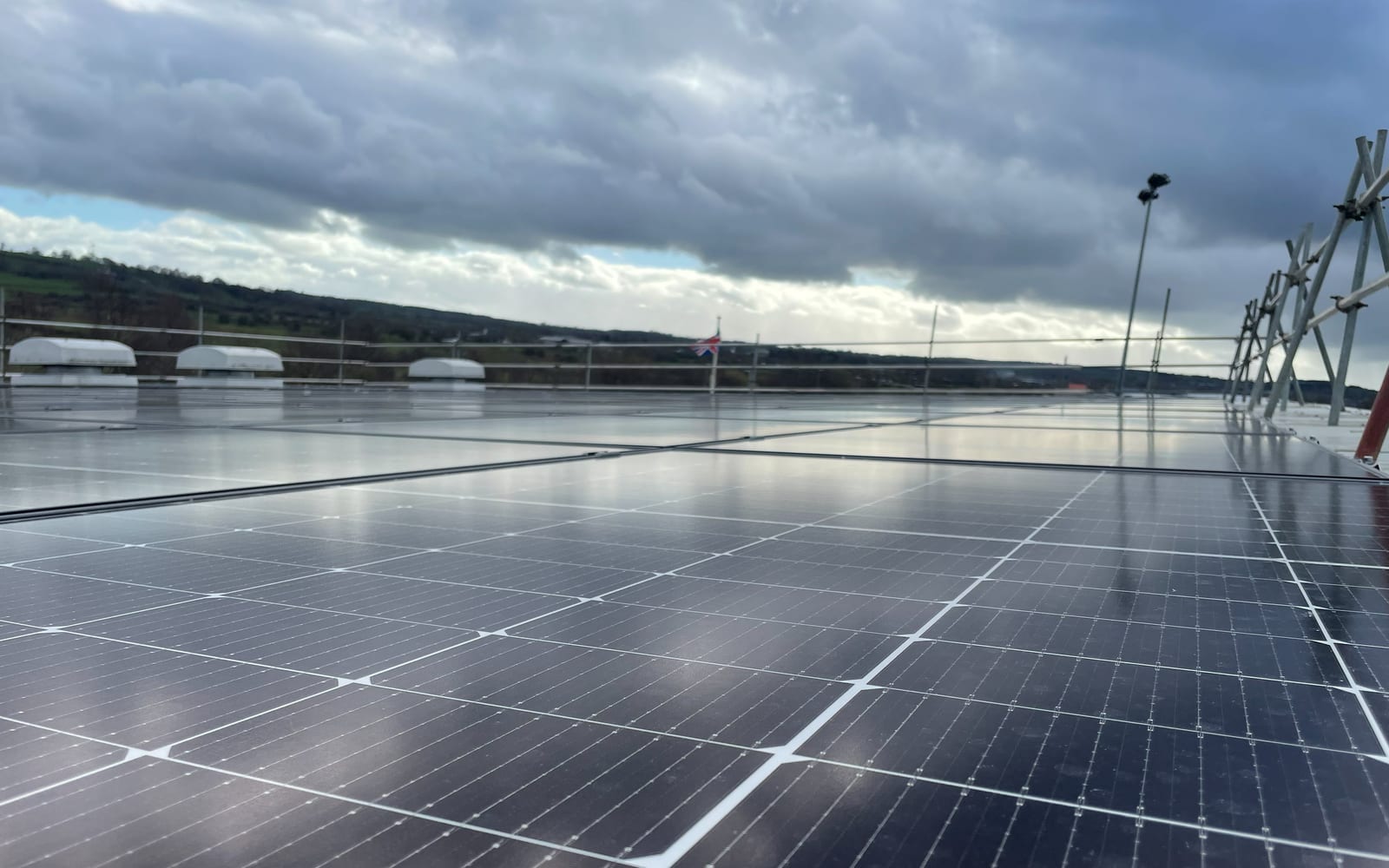
Start with the flat roof, because in this city it is the workhorse. Offices, depots and public buildings across the city carry flat roofs that earn nothing all year. The engineering answer is a ballasted array: panels on shallow-tilt frames, usually laid east–west, held by calculated ballast rather than penetrations, with the deck’s load capacity checked first. The honest caveat: shallow-tilt east–west systems sit at the bottom of the North East’s 800–950 kWh-per-kWp band, occasionally under it. A 60 kWp ballasted array on a city office roof returns very roughly 48,000–57,000 kWh a year — and because office demand tracks the working day, most of it is consumed on site at full import value. That arithmetic makes a nine-to-five building a quietly excellent solar host.
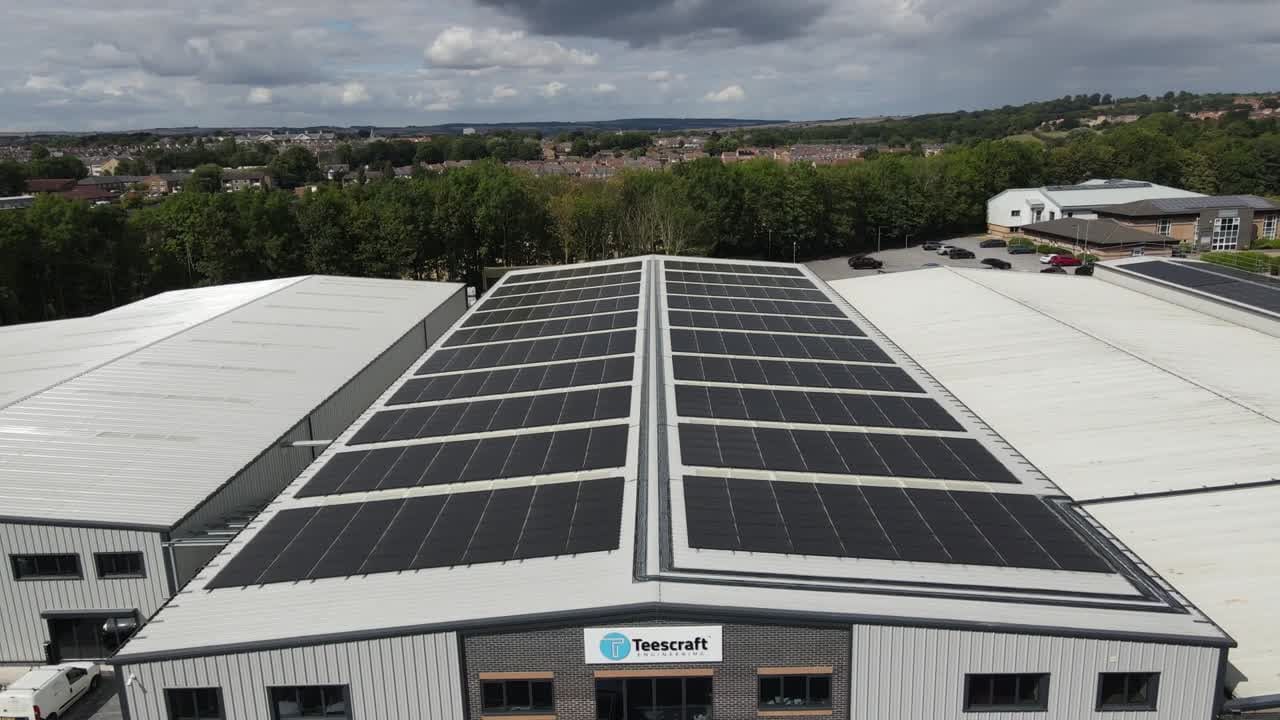
The exception to the no-sheds rule is the riverside. Along the Tyne at Walker, the Neptune Energy Park and the Offshore Technology Park — an Enterprise Zone since 2011 — carry genuinely industrial buildings for an offshore and subsea cluster whose occupiers include JDR, Baker Hughes and TechnipFMC Umbilicals. There is a neat irony available out there: buildings serving the offshore-energy industry, generating none of their own. East-end Newcastle is where our usual clamp-mounted work applies exactly as on any County Durham estate — and if the survey finds a board or supply that needs sorting first, the electrical side is our first trade, not a subcontract.
Then there is the centre, where the constraint is heritage. Grainger Town — the planned Georgian core — holds 450 buildings of which 244 are listed, inside one of England’s first designated conservation areas. Solar is not shut out of streets like that, but it proceeds on the conservation officer’s terms: concealed rear pitches, valley roofs, plant-screened flat sections. Listed and sensitive buildings are explicitly in scope for us — we would just rather talk consent realities at the survey than promise a fortnight and deliver a planning saga.
Institutional Newcastle rounds out the picture: the 24-acre Newcastle Helix quarter — home to the National Innovation Centres for Data and for Ageing — is the emblem of an economy of offices, labs and daytime loads, consuming power precisely when a roof produces it.
What Newcastle City Council is doing
Newcastle City Council does not treat net zero as decoration. Its Net Zero Newcastle 2030 Action Plan — approved in September 2020 — sets out more than 100 priority actions towards a net-zero city by 2030, and the city has held its place on the CDP Climate A-List for six consecutive years. A business generating its own power in Newcastle is pushing exactly where its council is already leaning.
Planning-wise, most non-domestic rooftop solar proceeds under permitted development — but Newcastle’s conservation areas add real limits on street-facing elevations, and its listed stock needs consent. We check the designation before we design, not after.
Local facts, sourced
Newcastle upon Tyne in numbers
Every figure below comes from a named public source — the same standard we hold our savings estimates to.
-
Newcastle City Council's Net Zero Newcastle 2030 Action Plan, approved in September 2020, sets more than 100 priority actions towards a net-zero city by 2030 — the earliest whole-area target in the North East.
Source: Newcastle City Council — newcastle.gov.uk/our-city/climate-change/net-zero-newcastle
-
Newcastle has held a place on the CDP Climate A-List — the top international tier for city climate action — for six consecutive years.
Source: Newcastle City Council — newcastle.gov.uk (citylife news)
-
Grainger Town holds 450 buildings of which 244 are listed — 29 Grade I and 49 Grade II* — inside one of England’s first conservation areas, so city-core solar runs through concealment-first design and, where listed, consent.
Source: en.wikipedia.org/wiki/Grainger_Town
-
The Neptune Energy Park and Offshore Technology Park at Walker — an Enterprise Zone since 2011 — anchor an offshore and subsea cluster whose occupiers include JDR, Baker Hughes and TechnipFMC Umbilicals, on genuinely industrial sheet-roofed buildings.
Source: Shepherd Offshore — shepherdoffshore.com; Invest North East England — investnortheastengland.co.uk/energy-gateway
-
Newcastle Helix is a 24-acre innovation quarter in the city centre, home to the National Innovation Centres for Data and for Ageing — emblem of an office-and-institution economy whose loads track daylight.
Source: Newcastle Helix — newcastlehelix.com
-
Newcastle upon Tyne's built-up area was home to 300,125 people at Census 2021 — the largest settlement in the North East.
Source: ONS Census 2021 — via en.wikipedia.org/wiki/List_of_settlements_in_Tyne_and_Wear_by_population
Data last reviewed: July 2026
Our work across the North East
The next step
Flat roof, riverside shed or Grainger Street stone — the first step is identical: a survey and a straight answer. See the wider Tyne & Wear picture, check the assumptions in the calculator, or put your building in front of us.
Newcastle upon Tyne commercial solar questions
Our building has a flat roof — can it take solar without drilling through the waterproofing?
Usually, yes — that is what ballasted mounting is for. Panels sit on shallow-tilt frames held by calculated ballast — no penetrations through the membrane. The two things we check hard first: the deck’s spare load capacity — ballasted systems are heavier than clamped ones — and wind exposure at edges and corners, where uplift peaks. If the deck cannot take the weight, we tell you before you spend anything.
We're in a conservation area but the building isn't listed — what are we allowed to do?
More than most owners expect. Permitted development still covers much rooftop solar in conservation areas — the main restriction bites on installations visible on elevations fronting a highway, so city-centre designs favour rear pitches and set-back arrays. It is a design constraint, not a prohibition. Listed buildings need consent — a different process, which we also handle.
You're based in County Durham — will a Newcastle job actually get looked after?
We are 45 minutes away, we batch Tyneside surveys and service visits so nobody waits on a one-off trip, and the firm that installed your system is the one that answers the phone in year six. What we will not do is rent a mailbox in NE1 and call ourselves local. Distance is a diary problem; we manage diaries well.
We're landlords of a multi-tenant office — who actually benefits if we put solar on it?
Both sides, if it is structured properly. The array cuts the landlord’s supply cost for common areas and, depending on metering, can supply tenant demand — recovered through the service charge or the energy terms of the lease. It also makes the building easier to let to tenants with carbon targets of their own. The legal structure is one for your solicitor; the metering, wiring and generation are ours.
Nearby
We also cover commercial solar in Gateshead, solar for Sunderland businesses and Washington commercial solar installers.
Get a straight answer for your Newcastle upon Tyne site
Get your free, no-obligation quote
Commercial solar, battery, EV or any electrical work — no pressure.