
Commercial Solar · County Durham
Commercial solar for Peterlee's industrial estates
Peterlee exists because somebody decided industry needed a town. Designated in 1948 under the New Towns Act and named after the Durham miners’ leader Peter Lee, it was planned — first, briefly, by the modernist Berthold Lubetkin — to gather East Durham’s colliery communities into a town with work beyond coal. The work came as factories, and the town was drawn around the estates built to hold them: the North West and South West Industrial Estates, purpose-planned land carrying some of the densest factory roof in County Durham.
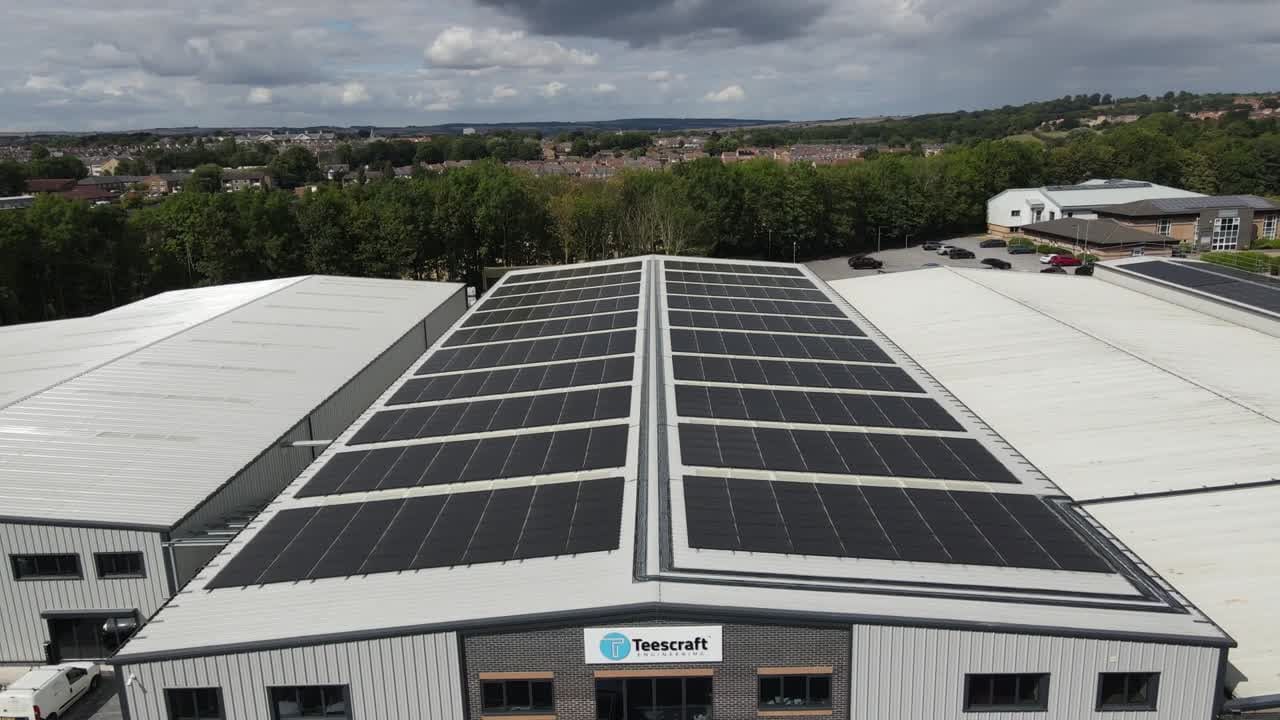
The anchors are serious. Caterpillar’s plant on the North West Industrial Estate is the global source of Cat articulated trucks — the full six-model range, the 70,000th machine already off the line. NSK picked Peterlee for its first European manufacturing plant in 1976, and its bearing complex — over 1,000 people at strength — has supplied wheel-hub bearings to Nissan in Sunderland. Around them sit tiers of suppliers and fabricators, in exactly the wide-span sheds clamp-mounted solar was made for.
From our St Helen Auckland base the drive is a little over 20 road-miles east — and this page reads more like an engineering note than a brochure, because Peterlee is where the survey kit earns its keep.
Solar on Peterlee's commercial buildings
Heavy manufacturing is a strong solar host for a simple reason: its load is big, flat and daytime, so self-consumption runs high without changing how the plant operates. At Peterlee’s scale the arithmetic is substantial — a 150 kWp array, mid-sized for this estate stock, produces roughly 120,000–142,500 kWh a year at North East yields, the bottom of the band on shallow-pitch sheet roofs. Where evening shifts stretch consumption past daylight, battery storage earns its look for peak-shaving as much as for shifting solar.
The estates’ age range is the survey’s first question. The earliest units date from the town’s first decades, and some still carry asbestos-cement roof sheets — which we do not mount solar on, full stop: the sheets are fragile, the fixings disturb the material, no array is worth it. The honest options are over-sheeting or replacement first, costed alongside the array as one decision and one budget. The modern big-plate stock — Peterlee has plenty — takes clamp-mounted rail as standard.
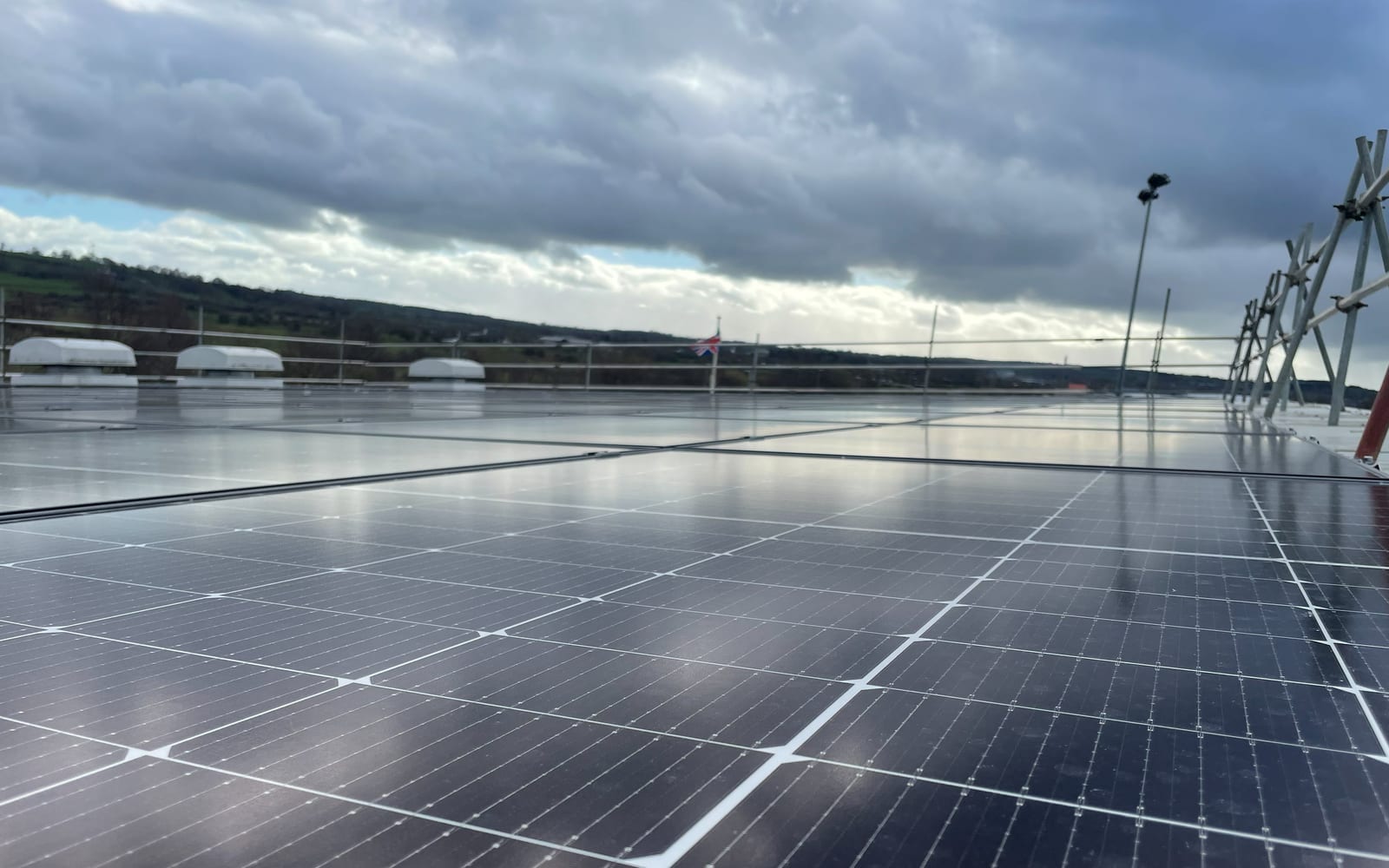
One line in our Peterlee specification that inland pages do not need: the North Sea is a couple of miles east, and marine air is corrosive over a 25-year design life. On exposed roofs the fixings, rail and fasteners get specified for it — stainless or coated components rather than the cheapest catalogue line. A small difference at order time; a large one in year twenty. The same logic runs through enclosures, containment and isolators — the contracting trade we have worked for 30 years, not an accessory to the panels.
The planned town also owns one of the boldest artworks in industrial Britain — Victor Pasmore’s Apollo Pavilion of 1969, Grade II* listed since 2011 — and Castle Eden Dene, the largest semi-natural woodland in North East England, runs 220 hectares along its southern flank. A town designed with factories, an artwork and a forest: the factory roofs are the part of the plan still waiting to be finished.
What Durham County Council is doing
Durham County Council is the unitary planning and rates authority, with Peterlee Town Council at parish level — the civic successors to the development corporation that built the place. The planning picture is friendly: most rooftop arrays proceed under permitted development, and we prepare prior approval where a larger system needs it.
The county’s 2045 net-zero target gives the direction; a planned industrial town generating on its own purpose-built roofs is about as literal as delivery gets. This economy was built by deliberate public design once already — the second energy transition is just quieter.
Local facts, sourced
Peterlee in numbers
Every figure below comes from a named public source — the same standard we hold our savings estimates to.
-
Caterpillar's plant on Peterlee's North West Industrial Estate is the global source of Cat articulated trucks — a six-model range, with the site's 70,000th truck already built.
Source: caterpillar.com — UK key facilities; Business Durham
-
NSK chose Peterlee for its first European manufacturing plant in 1976; the bearing complex has employed over 1,000 people and supplies wheel-hub bearings to Nissan's Sunderland plant.
Source: nsk.com — 50 Years of NSK Europe; UK Parliament EDM 12576
-
Peterlee was designated in 1948 under the New Towns Act, named after the Durham miners’ leader Peter Lee, with modernist Berthold Lubetkin its first architect-planner — a town purpose-designed around its industrial estates.
Source: englandsnortheast.co.uk/peterlee; tcpa.org.uk/new-town/peterlee
-
Victor Pasmore's Apollo Pavilion (1969) at Sunny Blunts has been Grade II* listed since 2011 — one of the most significant pieces of modernist public art in Britain, in a town of 20,324 people at Census 2021.
Source: Historic England list entry 1400364; ONS Census 2021 via en.wikipedia.org/wiki/Peterlee
-
Castle Eden Dene National Nature Reserve — around 220 hectares, the largest area of semi-natural woodland in North East England — lies largely within Peterlee, between the A19 and the coast.
Source: Natural England / en.wikipedia.org/wiki/Castle_Eden_Dene
-
Peterlee sits roughly two miles from the North Sea — so our arrays here carry a coastal fixing specification (stainless or coated components) that inland roofs do not need.
Source: OS mapping (town-to-coast distance); BS EN ISO 9223 (corrosivity environment classes)
Data last reviewed: July 2026
Our work across the North East
The next step
A town built on purpose deserves better than accidental energy costs. See how we handle factory-scale design, start from the County Durham hub, or put your estate unit in front of us.
Peterlee commercial solar questions
Our unit has an asbestos-cement roof — can you install solar on it?
No — and be wary of anyone who says yes. Asbestos-cement sheet is fragile, and fixing arrays to it disturbs material best left sealed. We price the real path instead: over-sheeting or re-roofing first, by licensed roofing contractors, with the array designed for the new roof from day one. It costs more than a bad idea, and considerably less than a bad idea gone wrong.
Does salt air off the North Sea wreck solar panels?
It attacks the cheap parts first — fasteners, clamps, unprotected steel — not usually the panels, which are glass-fronted and framed in anodised aluminium. The answer is specification, not avoidance: marine-appropriate fixings and rail, sensible detailing, and manufacturer warranty terms checked for coastal-distance clauses before kit is chosen. We design for the environment the building actually sits in.
We run welders, compressors and big motor starts — will solar interfere with the plant, or the plant with the solar?
Neither, in a properly designed system. Inverters synchronise to the grid, and the G99 process settles protection settings with Northern Powergrid before commissioning. Heavy plant is an input to the electrical design — supply capacity, board layout, where the generation lands — which is why it helps that the firm designing the array is an electrical contractor, not a panel reseller with a subcontracted sparky.
We're next to Castle Eden Dene — does a National Nature Reserve next door restrict a rooftop array?
Normally, no. Permitted development rights for rooftop solar on a commercial building do not switch off because a reserve adjoins the site. Where the designation genuinely matters is ground-mounted schemes or works near the reserve boundary, which attract closer planning scrutiny. If your building borders the Dene we check the position properly at survey rather than guessing either way.
Nearby
We also cover commercial solar in Barnard Castle, solar for Durham businesses and Bishop Auckland commercial solar installers.
Get a straight answer for your Peterlee site
Get your free, no-obligation quote
Commercial solar, battery, EV or any electrical work — no pressure.