
Commercial Solar · County Durham
Commercial solar in Barnard Castle and Teesdale
Barnard Castle is the smallest town we keep a dedicated page for — 5,344 people at the last census — and the reason is everything around it. This is Teesdale’s market town: the dale’s farms sell stock at its auction mart, buy feed at Harmire and bank on its high street. Farms are our preferred work, not tolerated work — and Teesdale is where that preference points.
It is also close: about 14 road-miles from our St Helen Auckland base straight down the A688 — the road our own yard sits beside. A Teesdale farm survey is a morning’s diary, not an expedition.
Solar on Barnard Castle's commercial buildings
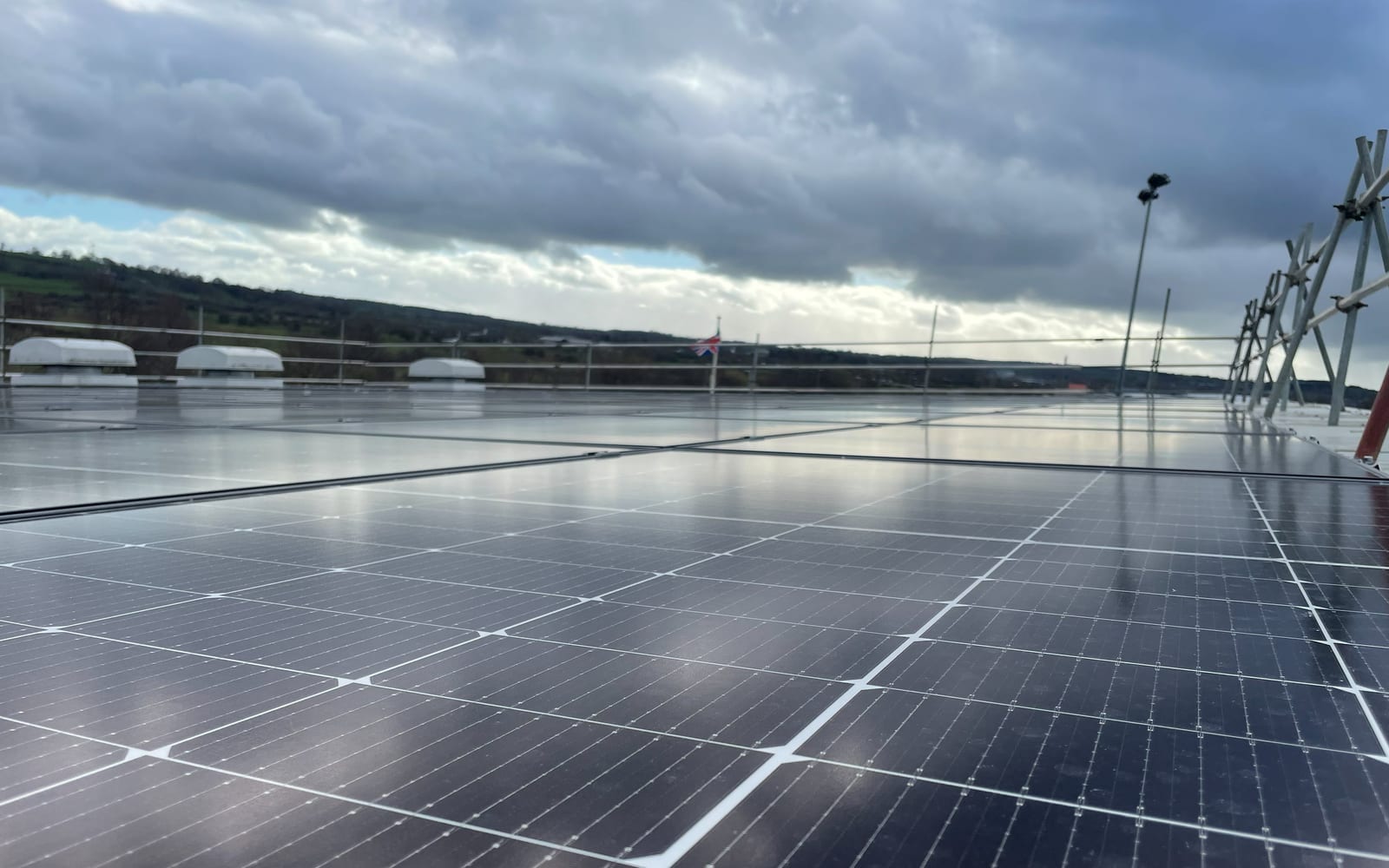
Start in the dale. Teesdale holdings run on steel-framed sheds — livestock housing, machinery stores, workshops — and the modern ones take clamp-mounted arrays as readily as any industrial unit. The honest surveying happens on older stock: fibre-cement sheets and lighter purlins need checking against the added load before anyone quotes, and some roofs are better re-sheeted first. The loads fit too: beef and sheep dominate the upland, but where there is milking in the lower dale there is a parlour and a cooler — a daytime load an array can feed.
A 40 kWp shed array — a common agricultural scale — returns roughly 32,000–38,000 kWh a year at North East yields, the bottom of the band on a shallow-pitch sheet roof; at the £700–£1,100 per kWp installed band, that is £28,000–£44,000 of capital doing the work of bought electricity for the panels’ 25-to-30-year design life. On remote holdings the catch is usually the connection, not the roof: a single-phase supply caps what you can export, sometimes what you should install — see the FAQ, because it changes the design.
This farm economy is a working one, not scenery: UTASS, the agricultural charity up the dale at Middleton-in-Teesdale, runs paperwork clinics, livestock-documentation help and retired farmers’ lunches at the Middleton and Barnard Castle auction marts. Where the support infrastructure is that established, the sheds, loads and bills are real.
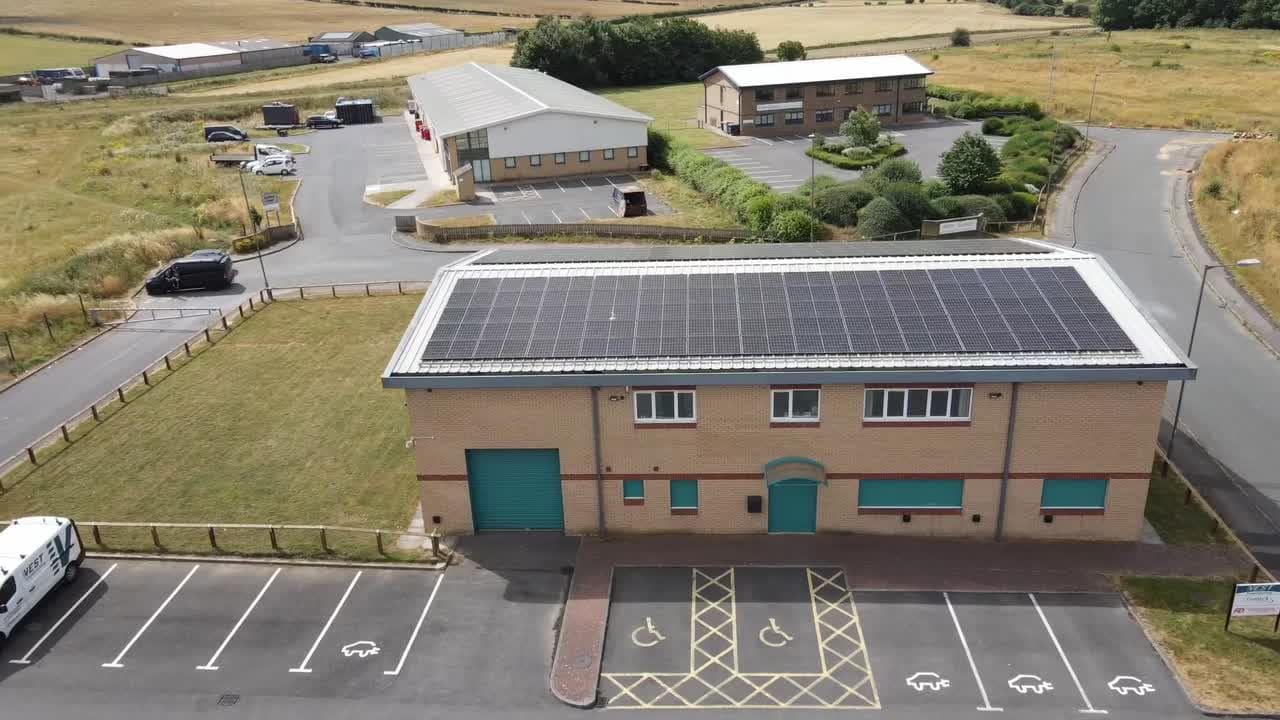
Now the improbable fact: GSK’s Barnard Castle site is one of the company’s biggest secondary manufacturing plants anywhere — around 1,100 people making sterile medicines, shipping nearly half a million packs a day to some 140 markets, with £92 million committed to a new aseptic facility. We name it as proof of what operates from this postcode, not as a customer. The everyday stock is more modest and very workable: Harmire Enterprise Park off the B6278 — occupiers include Royal Mail and Carrs Billington — and Stainton Grove Industrial Estate on the A688, eleven units of 538–2,991 sq ft with three-phase supply among them.
The third leg is visitors. The Bowes Museum — the purpose-built French-style château of 22 galleries John and Joséphine Bowes commissioned for the town — and the medieval castle above the Tees pull daytime, weekend-weighted footfall: hospitality’s load shape matching solar’s generating hours. Much of the centre is listed or in the conservation area; Grade II work is in our scope — meaning a design that starts from what a conservation officer will accept. On the farms, the same firm fitting the array handles the rewires, board upgrades and supply work older holdings usually need first — one contractor up the dale, not three.
What Durham County Council is doing
Durham County Council is the planning and rates authority, with Barnard Castle’s own town council at parish level. The distinctive layer is the North Pennines National Landscape — the designated landscape and UNESCO Global Geopark taking in upper Teesdale — whose staff team Durham County Council itself hosts. Designation does not shut farm solar out: rooftop arrays on agricultural buildings generally keep their permitted development route, while ground-mounted schemes inside the National Landscape get a harder look. We tell you which side of that line your project sits on before you spend anything.
The county’s 2045 net-zero direction reads differently in a dale: farm buildings quietly covering their own daytime loads, miles from the nearest substation — exactly the generation the grid edge likes best.
Local facts, sourced
Barnard Castle in numbers
Every figure below comes from a named public source — the same standard we hold our savings estimates to.
-
GSK's Barnard Castle site is one of its biggest secondary manufacturing plants globally — around 1,100 people, nearly half a million packs of medicines a day to some 140 markets, and a £92m aseptic-facility investment.
Source: GSK — gsk.com press release, UK manufacturing network investment
-
Harmire Enterprise Park, off the B6278, hosts occupiers including Royal Mail and the agricultural merchant Carrs Billington — the town's working commercial edge.
Source: UK Land Estates — Harmire Enterprise Park; agents' particulars
-
Stainton Grove Industrial Estate on the A688 offers eleven industrial units from 538 to 2,991 sq ft, with three-phase supply — Teesdale's small-business workshop stock.
Source: Business Durham — businessdurham.co.uk/business-premises/stainton-grove-industrial-estate
-
UTASS, the farming charity at Middleton-in-Teesdale (no. 1120120), supports Teesdale holdings with paperwork, livestock documentation and lunches at the Middleton and Barnard Castle auction marts.
Source: Charity Commission register (1120120); utass.org
-
Upper Teesdale sits inside the North Pennines National Landscape and UNESCO Global Geopark, whose staff team Durham County Council hosts — the planning context for farm installations up the dale.
Source: North Pennines National Landscape — northpennines.org.uk/what_we_do/about-us
-
The Bowes Museum — a purpose-built French-style château of 22 galleries commissioned by John and Joséphine Bowes — anchors a visitor economy whose daytime, weekend-heavy loads match solar generation hours.
Source: The Bowes Museum — thebowesmuseum.org.uk
-
Barnard Castle's population was 5,344 at Census 2021 — the smallest town on our map, kept because its agricultural catchment fits our work exactly.
Source: ONS Census 2021 — via censusdata.uk (E63000329)
Data last reviewed: July 2026
Our work across the North East
The next step
From a livestock shed up the dale to a workshop at Stainton Grove, the first step is identical: the building, the bills, and a straight answer 14 miles down the A688. See the County Durham hub, read how we design for farms and sheet roofs, or ask us up the dale.
Barnard Castle commercial solar questions
Our farm is on a single-phase supply — does that kill the project?
It constrains it; it rarely kills it. On single-phase, the fast-track connection route caps export at around 3.68 kW — beyond that we apply to Northern Powergrid under G99, and on a long rural feeder the answer may be an export limit. That is a design input, not a defeat: we size for on-site consumption first, apply export limitation where required, and cost a three-phase upgrade honestly if your plans justify it. We will not sell you an array your connection cannot legally use.
We're inside the North Pennines National Landscape — are we allowed solar at all?
Almost certainly, on a roof. Permitted development for rooftop solar on agricultural and commercial buildings continues to apply in designated landscapes, subject to conditions on how the installation presents. What the designation genuinely tightens is ground-mounted and field-scale work, which needs a planning application and a sympathetic design case. We check your position at survey and prepare whatever the honest route requires.
Our sheds are older — some fibre-cement, one with timber purlins. Can they take panels?
That is what the survey answers before anyone quotes. Panels and mounting typically add in the low tens of kilograms per square metre; a modern steel portal shed shrugs at that, an older fibre-cement roof on light purlins may not — and fragile sheeting is a safety question as well as a structural one. Sometimes the answer is a partial array on the sound section; sometimes re-sheeting first, priced alongside the array as one job. We tell you which, and why.
Do you work on regulated sites — audited premises, permits to work, strict contractor controls?
Yes — that is ordinary life for a commercial electrical contractor. RAMS, inductions, permit-to-work regimes, phased access and documented testing are how our electrical work has run for decades; the solar side inherits those habits rather than learning them on your roof. If your site audits its contractors, ask for the paperwork early — we would rather be checked than taken on faith.
Nearby
We also cover solar for Durham businesses, Bishop Auckland commercial solar installers and commercial solar in Newton Aycliffe.
Get a straight answer for your Barnard Castle site
Get your free, no-obligation quote
Commercial solar, battery, EV or any electrical work — no pressure.