Commercial Solar · County Durham
Commercial solar installers in Durham
Durham is really two commercial cities sharing one skyline. There is the historic core — the cathedral and castle have been a UNESCO World Heritage Site since 1986, among the first in Britain — where planning is rightly cautious and any solar conversation starts with a conservation officer. And there is the working ring around it: Belmont, Dragonville, Bowburn, Aykley Heads. That ring holds most of the city’s roof area, and most of its solar potential.
We treat Durham as our priority patch. The drive from our St Helen Auckland base is around a dozen miles up the A688 and A167 — a survey here is a morning’s diary slot, and a snagging visit after commissioning is never a negotiation.
Either side of the city’s divide, the offer is identical: a design built from your consumption data, the G99 connection application to Northern Powergrid handled for you, and a straight answer if yours is a building where solar does not pay.
Solar on Durham's commercial buildings
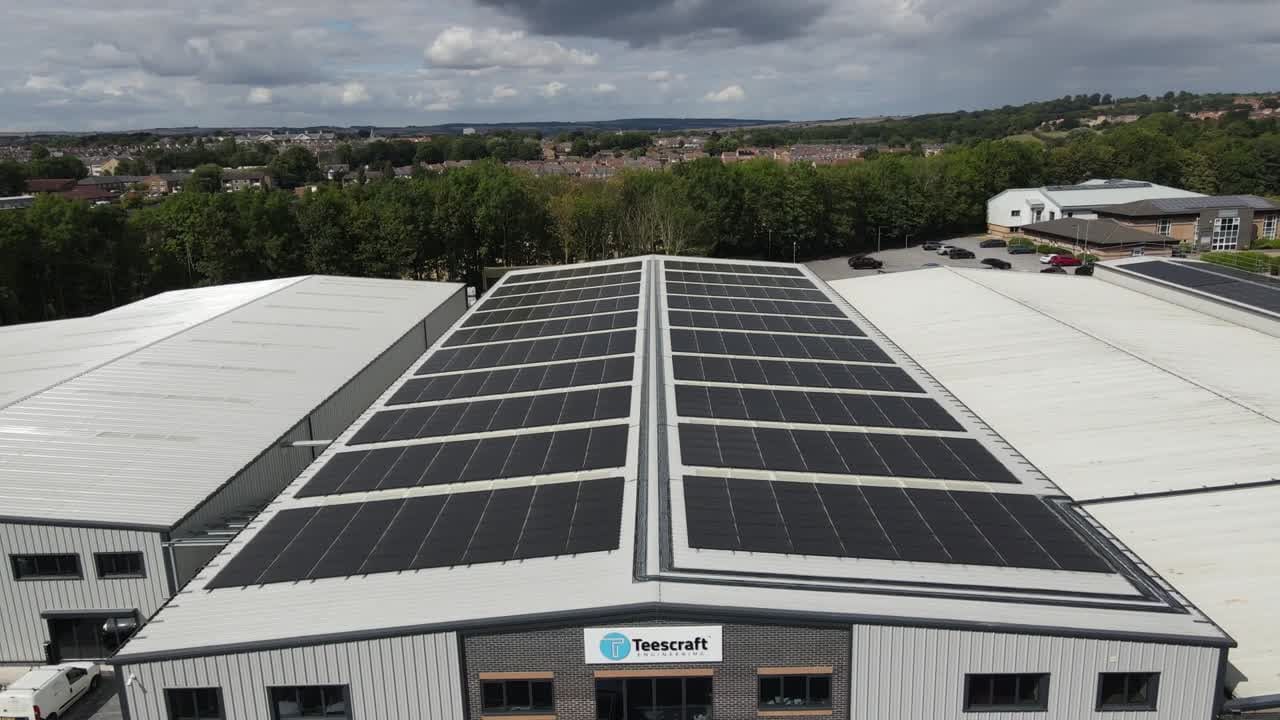
Take Belmont first, because it is the template for the city’s industrial stock. The estate covers some 42 hectares two miles east of the centre, immediately off the A690’s junction with the A1(M). Agents’ particulars for its units read like a specification for solar readiness: steel portal frame construction, brick or composite-panel elevations, steel profile sheeting roofs. That profiled sheet is our preferred canvas: clamp-mounted arrays, no wet trade, installs measured in days.
Dragonville Industrial Park sits alongside on Dragon Lane, carrying the same era and class of stock into the DH1 postcode. Further south at Bowburn the scale changes: Integra 61, a 205-acre development at junction 61 of the A1(M), is bringing forward up to three million square feet of logistics and industrial space — Amazon is already there — and buildings of that vintage have the long, clean roof plates that make large arrays straightforward to engineer.
The other half of Durham’s story is offices and institutions. Aykley Heads, north of the centre, is being developed as the Durham Innovation District — a 62-hectare site with consent in place towards thousands of jobs in new commercial floorspace, delivered with Durham University and the county council. New offices mean daytime loads, drawing power precisely when a roof generates. In the historic core, listed and conservation-area premises are not shut out — just on the slower road of listed building consent and concealment-first layouts. Grade II work is explicitly in scope for us, and Durham has more of it than anywhere else in the county.
On yield we quote Durham as the North East city it is: 800–950 kWh a year per installed kWp on a well-oriented roof, shallow-pitch sheds at the lower end. What tips the economics is load, not latitude — a Belmont unit running machinery through the working day uses its own generation at full import value.
What Durham County Council is doing
Durham County Council runs the city — it is the unitary authority for the whole county, headquartered here. Its climate commitments are concrete: net-zero for its own operations by 2030 and for County Durham as a whole by 2045, with the third Climate Emergency Response Plan (2024–2027) setting out delivery.
The growth side of that policy is visible from the ring road: a Durham Mayoral Development Zone now backs the Aykley Heads plans, with £27m of North East Combined Authority funding announced. Public money is pulling commercial development, and its energy demand, into the city — generating on your own roof is the one part of that economy a business owns outright.
Local facts, sourced
Durham in numbers
Every figure below comes from a named public source — the same standard we hold our savings estimates to.
-
Durham's cathedral and castle have formed a UNESCO World Heritage Site since 1986 — so rooftop solar in the historic core runs through listed building consent and conservation review, a process we handle.
Source: UNESCO World Heritage List — whc.unesco.org/en/list/370
-
Belmont Industrial Estate covers around 42 hectares beside the A690/A1(M) junction, two miles east of the centre; its typical units are steel portal frame with steel profile sheeting roofs — the construction clamp-mounted solar is designed for.
Source: Vernon Holdings / agents' particulars — vernonholdings.co.uk/belmont-industrial-estate
-
Integra 61 at Bowburn (A1(M) J61) is a 205-acre scheme with up to 3 million sq ft of industrial and logistics space; Amazon's occupation created 1,000 jobs.
Source: Durham County Council — durham.gov.uk/article/24242
-
The 62-hectare Aykley Heads site is being developed as the Durham Innovation District, with planning consent in place towards up to 4,000 jobs.
Source: Durham County Council — durham.gov.uk/aykleyheads
-
Durham's built-up area was home to 50,510 people at Census 2021.
Source: ONS Census 2021 — via en.wikipedia.org/wiki/Durham,_England
-
Durham County Council, headquartered in the city, targets net-zero for its own operations by 2030 and county-wide by 2045.
Source: Durham County Council Climate Emergency Response Plan — durham.gov.uk
Data last reviewed: July 2026
Our work across the North East
The next step
Sheet roof or listed stone, Durham businesses get the same thing from us: a survey, real numbers from the calculator’s assumptions, and a quote only if the maths deserves one. Start on the County Durham hub for the wider picture, or talk to us about your building.
Durham commercial solar questions
Can we put solar on a listed building or in Durham's conservation area?
Often yes, with patience. Permitted development rights do not apply to listed buildings, so a premises near the peninsula needs listed building consent, and the approved design will usually favour concealment — a rear pitch, a valley roof, an outbuilding — over maximum output. We take on Grade II work and would rather talk consent realities at the survey than promise speed we cannot deliver.
Our unit is on Belmont or Dragonville — is the roof suitable?
Very probably, and we can usually tell you within an hour on site. Most units on both estates are portal-frame buildings whose profiled steel roofs take clamp-mounted arrays cleanly. The survey checks purlins, fixings and sheet condition first — panels and mounting typically add somewhere between 12 and 20 kilograms per square metre — and if a roof is near the end of its life, we say so before you spend anything.
How quickly can you get to a Durham job?
Our base is at St Helen Auckland, around twelve miles away — close enough for a survey within days, and for aftercare that means a van, not a call centre. Durham is our priority area, not an outer ring on someone else’s map.
Do new units at Integra 61 or Aykley Heads need solar designed in from the start?
It is cheaper if it is. On a new or newly fitted-out building, roof loading allowance, DC routes and board capacity can all be specified before the slab is poured — and because solar is electrical contracting at heart, we can handle the wider electrical fit-out alongside the array rather than bolting it on afterwards.
Nearby
We also cover commercial solar in Bishop Auckland, solar for Newton Aycliffe businesses and Spennymoor commercial solar installers.
Get a straight answer for your Durham site
Get your free, no-obligation quote
Commercial solar, battery, EV or any electrical work — no pressure.