
Commercial Solar · Teesside
Commercial solar in Hartlepool, the energy town
No town on this site knows more about energy than Hartlepool. Its nuclear power station has fed the grid since the 1980s and has just had its generating life extended to March 2028; the plan for what follows is bigger — Centrica and the US reactor developer X-energy have agreed to develop up to twelve small modular reactors on the site, around 960 MW of new capacity, with first power planned for the mid-2030s. At Able Seaton Port, the town marshals offshore wind: Hornsea One’s foundations shipped out from here across a thirteen-month campaign, and Dogger Bank A and B chose the port as their turbine installation base. JDR, which engineers the subsea cables that bring that power ashore, does its final assembly in Hartlepool.
Here is the irony: every business under those gigawatts still buys electricity at full commercial rates — the town can export terawatt-hours without moving your unit price a penny. The one piece of the energy economy a Hartlepool business can own outright is the roof over its head, which is the modest, bankable end of the industry we work in — a forty-five-minute drive from our yard near Bishop Auckland.
Solar on Hartlepool's commercial buildings
The working roofs sit in a ring around the town. Queens Meadow Business Park, two miles south-west of the centre, is the flagship — around 150 acres of modern business-park stock, with Enterprise Court’s terraces of workshop units and an innovation centre for start-ups. North of the centre, Oakesway carries some 161,000 sq ft of workshops, storage and light-industrial space, and Longhill runs 37 units across six terraces off Ullswater Road — between them the classic small-to-mid unit stock where North East businesses actually work.
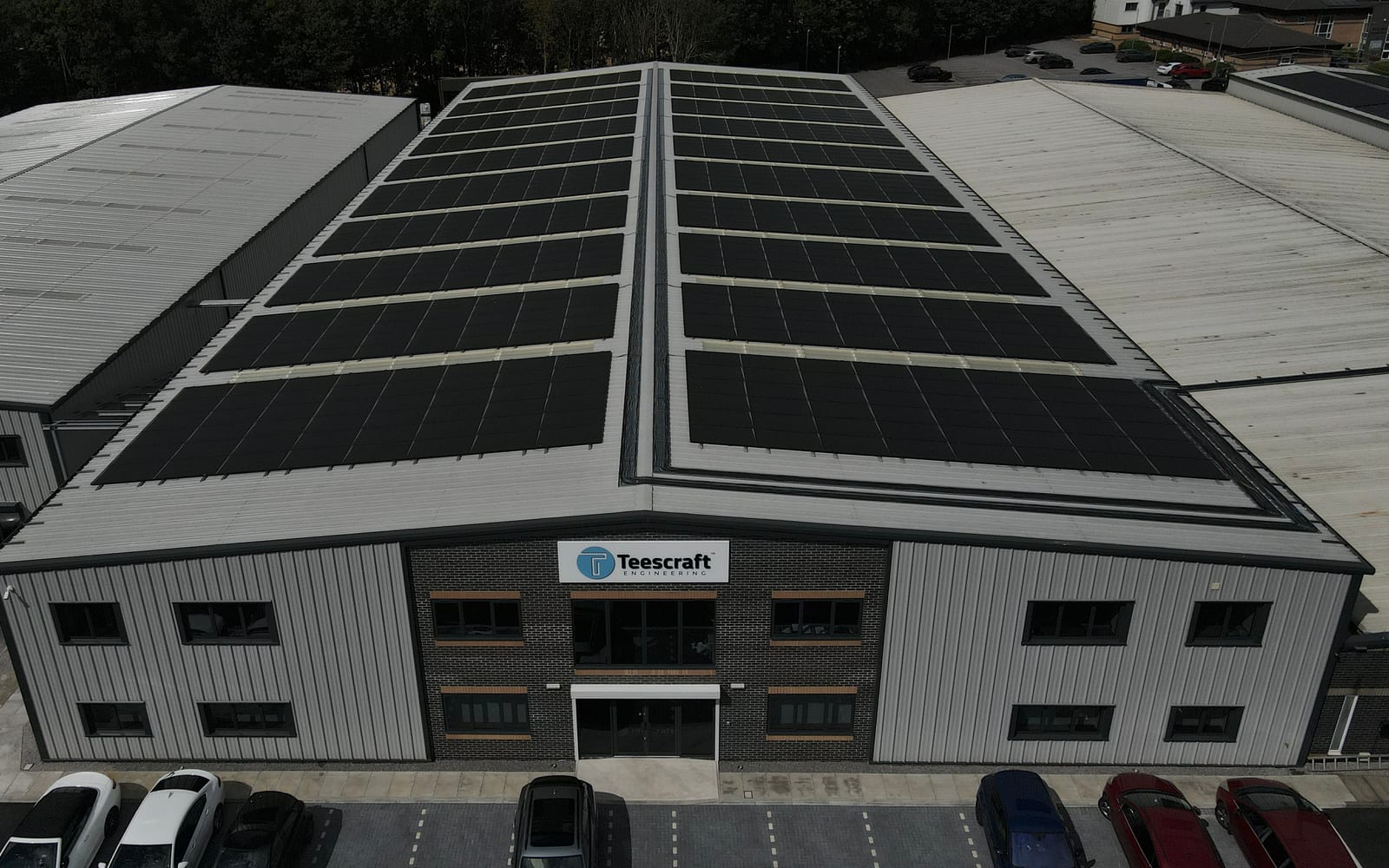
The worked example at that scale: a 75 kWp array — a common size for one good workshop roof — produces roughly 60,000 to 71,250 kWh a year at North East yields. Run refrigeration, machining or process load through the day and the bulk of that offsets electricity at full import rate; where a chilled load never switches off, solar carries the daytime baseline while battery storage is priced against the rest.
One Hartlepool-specific note, offered straight: this is a coastal town and we design like it. Salt air is harder on fixings, rails and terminations than anything inland, and North Sea gusts load a roof edge in ways a sheltered valley never sees. That is spec-sheet and wind-calculation work — unglamorous territory that suits us, because electrical contracting is the trade we have run for thirty years, and an array is only as durable as the hardware behind it.
What Hartlepool Borough Council is doing
Hartlepool Borough Council adopted its Climate Change Response and Net Zero Strategy in November 2023: net-zero for the council’s operations and services by 2050, pursued by cutting emissions roughly 30% every five years — a stepped, audit-it-as-you-go approach rather than a distant pledge. Set beside the nuclear and offshore build-out on its doorstep, the borough’s direction is not in doubt — a business generating on its own roof pulls the same way, and most estate arrays proceed under permitted development rather than through a planning fight.
The town itself held steady at 92,300 people at Census 2021 — a compact borough where the estates, the port and the power station are all minutes apart.
Local facts, sourced
Hartlepool in numbers
Every figure below comes from a named public source — the same standard we hold our savings estimates to.
-
Hartlepool's nuclear power station has had its generating life extended to March 2028 — and Centrica and X-energy have agreed to develop up to 12 small modular reactors (~960 MW) on the site, with first power planned for the mid-2030s.
Source: EDF — edfenergy.com; World Nuclear News (Centrica/X-energy joint development agreement)
-
Able Seaton Port served as the installation base for Hornsea One's foundation package across a 13-month campaign and was chosen as the turbine installation base for Dogger Bank A and B.
Source: Able UK — ableuk.com; offshorewind.biz
-
JDR Cable Systems performs final assembly of subsea power cables at its Hartlepool facility, supplying offshore wind farms including Hornsea One and Two.
Source: JDR — jdrcables.com
-
Queens Meadow Business Park covers around 150 acres two miles south-west of the town centre, with modern unit stock, Enterprise Court's 21 workshops and an innovation centre.
Source: Tees Valley Combined Authority — teesvalley-ca.gov.uk/business/queens-meadow-business-park
-
Oakesway Industrial Estate carries around 161,000 sq ft of workshop and light-industrial space north of the centre; Longhill Industrial Estate adds 37 units across six terraces off Ullswater Road.
Source: Commercial agents' particulars — NT Properties (Longhill); NewOfficeEurope (Oakesway); Teesside Live (Oakesway expansion plans)
-
Hartlepool Borough Council's Net Zero Strategy, adopted November 2023, targets net-zero council operations and services by 2050 via emissions cuts of roughly 30% every five years.
Source: Hartlepool Borough Council — hartlepool.gov.uk/climate-change/climate-strategy
-
Hartlepool's population was 92,300 at Census 2021.
Source: ONS Census 2021 — ons.gov.uk/visualisations/censuspopulationchange/E06000001/
Data last reviewed: July 2026
Our work across the North East
The next step
The town already exports energy at every scale but one. Fix that from your own roof: read the wider Teesside hub, test the numbers in the calculator, or get the coastal survey booked.
Hartlepool commercial solar questions
Hartlepool has a nuclear station and an offshore wind port — why would a local business bother with rooftop solar?
Because none of that capacity discounts your invoice. Grid-scale generation sells into the national market; your business buys back at full commercial rates, standing charges included, however many gigawatts leave the town. Rooftop solar is the one layer of the energy system where the generator and the customer are the same company — yours — so the saving lands on your bill instead of the wholesale market.
Does the sea air shorten a solar system's life?
It shortens the life of anything specified carelessly, so we do not specify carelessly: rails, fixings and external terminations chosen with coastal corrosion in mind, dissimilar metals kept apart, connectors and isolators sited out of the weather. Reputable panels are tested for salt-mist environments; what fails early on cheap coastal installs is the bracketry and balance-of-system hardware — exactly where the specification, and the contractor, earns its money.
Our roof takes the full North Sea wind — will panels stay on it?
Designed properly, yes — wind is a calculation, not a gamble. An exposed roof gets a wind-load assessment before layout: edge and corner zones where uplift concentrates are avoided or fixed more densely, clamp torques and pull-out values matched to the actual sheet profile, the array set back as far as the calculation demands rather than the panel count prefers. If a roof cannot honestly carry an array in its exposure we say so at survey — a smaller, better-anchored system beats one you think about every time the forecast turns.
We run cold storage near the docks — is solar or a battery the better first step?
Solar first, almost always, then let the data decide the battery. Refrigeration is the friendliest load in the business — flat, constant, seven days a week — so an array’s output is consumed the moment it is generated, right through weekends. Once its meter data shows what evenings still cost, the battery either earns its case from your half-hourly profile or it does not — we show that arithmetic rather than assert it. Sizing both at once, unmetered, is how systems get overbought.
Nearby
We also cover commercial solar in Middlesbrough, solar for Stockton-on-Tees businesses and Darlington commercial solar installers.
Get a straight answer for your Hartlepool site
Get your free, no-obligation quote
Commercial solar, battery, EV or any electrical work — no pressure.