
Commercial Solar · Tyne & Wear
Commercial solar in Washington
Washington was planned by engineers and named for them. Designated the North East’s second new town on 24 July 1964, it was built to a deliberate pattern: each of the town’s villages was laid out with its own industrial estate, and the estates carry the names of the region’s great engineers — Parsons, Armstrong, Stephenson, Crowther, Pattinson, Swan, Emerson. Where County Durham’s new town at Aycliffe put its industry in one enormous park, Washington scattered its working buildings through the town in a planned grid — so, sixty years on, almost nowhere in Washington is far from a commercial roof.
The town of 67,085 sits mid-way between the A1(M) and the A19, threaded by its own dual-carriageway network — a position that made it a natural home for distribution and mid-size manufacturing, and makes it an easy run for us: about 24 road miles from our St Helen Auckland base, 40 minutes up the A1(M). We are a Bishop Auckland-based contractor working into Washington, not a local branch.
Solar on Washington's commercial buildings
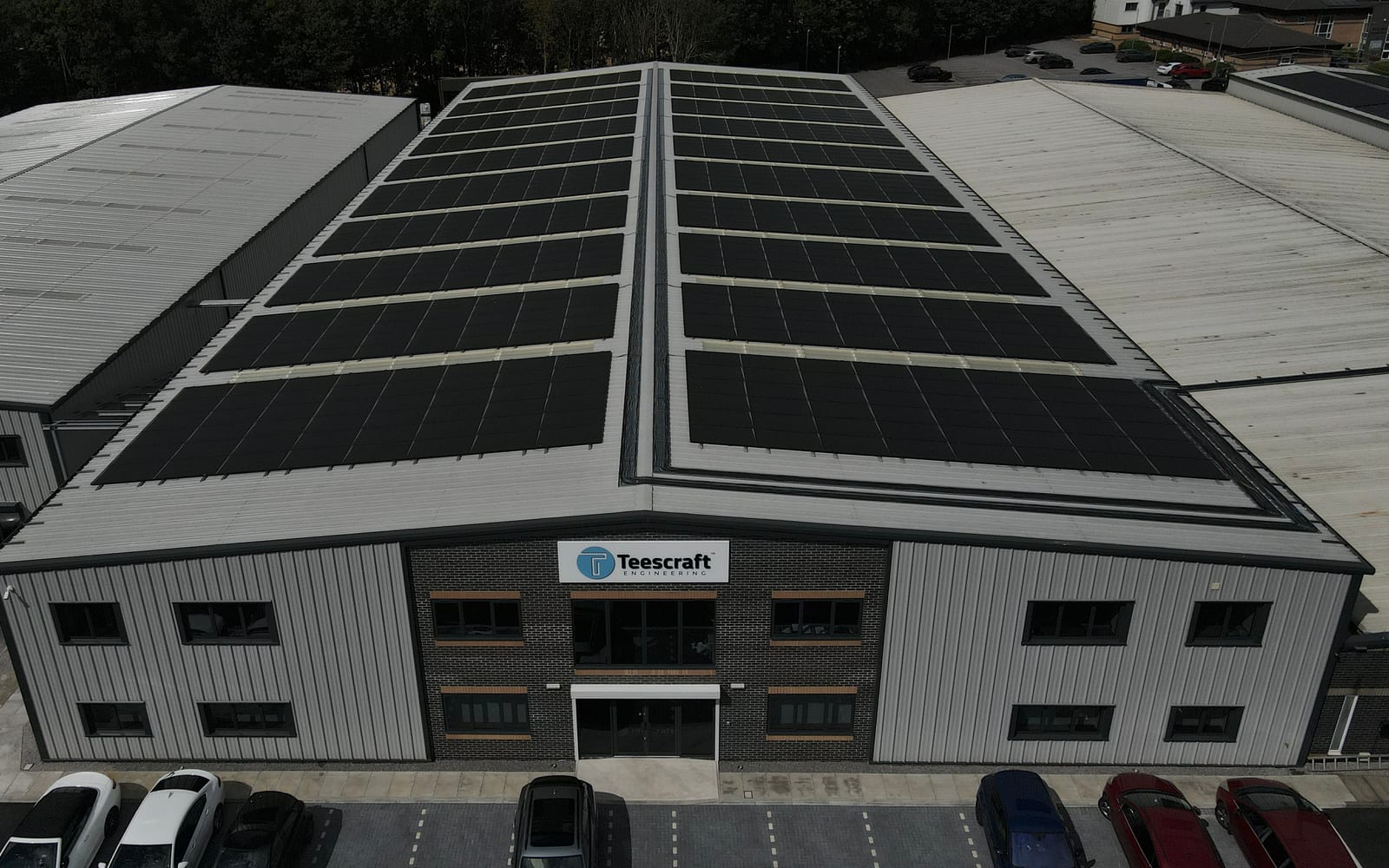
The corridor position shapes the stock: Washington’s estates carry a high share of distribution and logistics buildings — long-span, big-plate roofs where the arithmetic gets serious fast. A 400 kWp array on a distribution shed returns roughly 320,000–380,000 kWh a year at North East yields. The discipline that matters on these buildings: a warehouse’s daytime electrical load is often modest relative to its enormous roof, and an array sized to the roof rather than the load exports most of its output at a fraction of import value. We size from your consumption data and the export maths together — sometimes the right answer on a five-acre roof is a two-acre array, and we show you why in numbers.
The other Washington honesty is age. New-town industrial building ran hard through the sixties and seventies, and some original units carry fibre-cement roof sheets — a material that cannot take clamp-mounted arrays and is fragile to work on. Where the survey finds it, the options are real but different: over-sheeting or re-roofing first, then an array on the new skin, priced as one decision. Plenty of Washington stock has been re-clad since and mounts cleanly; the survey tells us which building you have.
And yes — the region’s most famous factory sits on the former Sunderland airfield immediately north of the town. The Nissan story, its wind-and-solar farms and the supply-chain park beside it belong to our Sunderland page, but its gravity is felt on every Washington estate: suppliers, logistics contracts, a grid area where serious renewable generation is already normal. For an ordinary Washington business the lesson is not the scale, it is the direction — and your own roof is the piece of it you control. Solar is electrical contracting at heart, and thirty years of the wider electrical trade come with the same van.
What Sunderland City Council is doing
Washington has been part of the City of Sunderland since 1974, so Sunderland City Council is the planning and rates authority here, and its carbon-neutral-city-by-2040 commitment covers every estate in the town. The steepness of that path is worth sitting with: hitting 2040 requires the city’s emissions to fall by roughly 14.4% every year. Targets like that are not met by councils alone — they are met building by building, and commercial premises are where the biggest single strides get made.
Planning is rarely the obstacle: most rooftop commercial arrays in Washington proceed under permitted development, and new-town zoning — industry separated onto its estates — means fewer neighbour conflicts than older towns manage.
Local facts, sourced
Washington in numbers
Every figure below comes from a named public source — the same standard we hold our savings estimates to.
-
Washington was designated the North East's second new town on 24 July 1964, planned to a target population of 70,000–80,000 — with each village laid out around its own industrial estate.
Source: The National Archives — Washington New Town (Development Corporation) Order 1964; en.wikipedia.org/wiki/Washington,_Tyne_and_Wear
-
The town's estates are named after the region's engineers — Parsons, Armstrong, Stephenson, Crowther, Pattinson, Swan and Emerson — a dispersed grid of commercial roofs threaded through the town rather than one consolidated park.
Source: en.wikipedia.org/wiki/Washington,_Tyne_and_Wear
-
Washington sits mid-way between the A1(M) and the A19 on its own dual-carriageway network — the corridor position that built its distribution and manufacturing base, 40 minutes from our County Durham yard.
Source: Road network (OS/Google Maps); measured road route, St Helen Auckland DL14 → NE37/NE38
-
The Nissan plant — with its on-site wind and solar generation — stands on the former Sunderland airfield immediately north of the town, making Washington’s grid area one where industrial-scale renewables are already normal.
Source: en.wikipedia.org/wiki/Washington,_Tyne_and_Wear (plant siting); generation detail cited on our Sunderland page
-
Sunderland's carbon-neutral-city-by-2040 commitment — which covers Washington — requires emissions to fall by roughly 14.4% per year, a pace only reachable if commercial buildings decarbonise alongside the council's own estate.
Source: Sunderland Echo — sunderlandecho.com (Low Carbon Framework coverage)
-
Washington's built-up area was home to 67,085 people at Census 2021.
Source: ONS Census 2021 — via citypopulation.de (E63000124)
Data last reviewed: July 2026
Our work across the North East
The next step
A town built by engineers deserves engineering, not brochures. Start with the Tyne & Wear hub, compare notes with Sunderland next door, or send us your building — the survey verdict is straight, whichever estate you are on.
Washington commercial solar questions
Our unit is 1970s new-town stock — can the roof take solar at all?
It depends on the sheet, and we check before anything else. Some original fibre-cement roofs cannot be clamp-mounted and are fragile to work on — for those, the honest route is over-sheeting or re-roofing first, then an array on the new skin, costed as one project. Either way you get a verdict from the survey, not a sales pitch that discovers the problem on install day.
Our shed roof is enormous but we don't use much power in the day — should we fill the roof anyway?
No — and an installer who says otherwise is selling panels, not payback. Exported electricity earns a fraction of what imported electricity costs, so an array sized far beyond your daytime load has weak economics. We size from your consumption data first, then look at whether a battery profitably shifts surplus into your evening operations. Sometimes the right design uses a third of the roof; the numbers decide, not the acreage.
Which parts of Washington do you actually cover?
All of the grid — Parsons, Armstrong, Stephenson, Crowther, Pattinson, Swan, Emerson and the estates between. The new town’s road layout means nothing in Washington is more than a few minutes off a dual carriageway, so we typically cluster several surveys into one trip north. If your building is here, it is covered.
Does sitting next to Nissan change anything for an ordinary Washington business?
Less than the headlines suggest, and more than nothing. The plant’s renewables and the microgrid around it serve the plant and its immediate suppliers — they will not cut your bill. What the neighbourhood does give you is a grid area and a council where large-scale local generation is established practice, and a supply-chain economy that increasingly asks about carbon. The part of that transition you own outright is your roof.
Nearby
We also cover commercial solar in South Shields, solar for Newcastle upon Tyne businesses and Gateshead commercial solar installers.
Get a straight answer for your Washington site
Get your free, no-obligation quote
Commercial solar, battery, EV or any electrical work — no pressure.